A blocked drain is disruptive in any workplace. At a busy waterfront restaurant, hotel, visitor attraction, shop or office, the effects can spread quickly: toilets become unavailable, a kitchen cannot operate normally, an outside gully overflows near customers or a delivery area has to be closed.
The answer is not to jet every pipe at fixed intervals whether it needs it or not. Useful drainage maintenance starts with the site: what connects where, which parts are private, what enters each drain and what would stop the business from operating if it failed.
This matters across Portsmouth’s waterfront and coastal commercial areas, including premises around Gunwharf, Old Portsmouth, the harbour, Port Solent and Southsea seafront. These sites are not all built alike. A converted historic building with a small yard has different risks from a modern restaurant unit, marina facility, hotel or multi-tenant commercial block.
The purpose of a maintenance plan is therefore simple: identify the drains that matter most, deal with predictable build-up before flow is lost, and keep enough evidence to make sensible decisions when a problem appears.
Why waterfront premises need a site-specific plan
Being near the coast does not automatically mean seawater is entering a building’s private drains. Nor does the word “waterfront” explain every blockage. The relevant conditions are more practical:
- exposed gullies and channels may collect windblown grit, litter, leaves and organic debris;
- hospitality premises can place sustained loads on kitchen and toilet drainage;
- outside seating, service yards and delivery routes may depend on clear surface-water drainage;
- restricted access can make an unplanned callout more disruptive;
- older or adapted buildings may contain altered drainage routes and concealed chambers;
- a shared or managed development may divide responsibility between an occupier, landlord, managing agent and water company;
- seasonal trade can make the timing of maintenance as important as the work itself.
Portsmouth City Council’s surface-water flooding guidance makes an important distinction. City-wide surface-water planning deals with rainfall before it enters underground systems and identifies wider local risks; it does not treat a very local failure, such as a leaf-blocked gully, as the same problem. A business should make the same distinction. A blocked private channel, an overloaded public sewer and coastal flooding need different responses.
Start with a drainage map, not a cleaning schedule
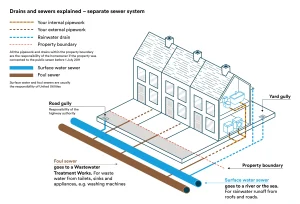
Before deciding what needs cleaning, establish what the site actually has. Many commercial drainage problems take longer to resolve because no one on duty knows where the inspection chambers are, which toilets share a branch or whether a surface-water gully connects to the foul system.
A useful site drainage record should show, as far as reasonably possible:
- foul-water drains from toilets, kitchens and staff facilities;
- surface-water routes from roofs, yards, paths and parking areas;
- inspection chambers and rodding access points;
- channel drains, gullies, silt traps and catch pits;
- grease-management equipment;
- private pumping equipment, if present;
- any non-return valve or other backflow device;
- the point at which private drainage connects to a shared or public sewer;
- areas where access is restricted by storage, outdoor furniture, parked vehicles or security controls.
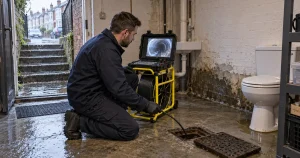
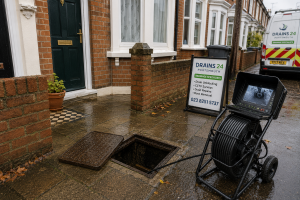
Old plans can help, but they should not be treated as proof that the live system still follows the drawing. Refurbishments, extensions and changes of use can alter pipe routes. If the layout is uncertain, a CCTV drain survey in Portsmouth can help trace accessible runs and identify connections, defects or places where waste is collecting.
The finished plan does not need to be architectural artwork. It needs to be clear enough for a manager or engineer to find the relevant access point during a problem.
1. External gullies, channels and surface-water routes
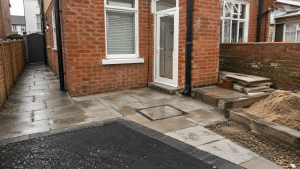
Outside drainage is easy to overlook because it may appear to work in light rain. The restriction only becomes obvious when rainfall intensifies or debris moves across the grate.
Checks should include:
- removing leaves, litter and loose surface debris from grates;
- checking channel drains along entrances, terraces and delivery areas;
- examining gullies for silt, grit, moss and standing water;
- confirming that covers and grates are secure and not creating a trip risk;
- checking that paving falls towards the intended collection point rather than towards a doorway;
- inspecting accessible silt traps or catch pits before they fill;
- making sure stored goods, bins and outdoor furniture do not obstruct drainage paths;
- checking roof downpipes and their discharge points for obvious overflow or disconnection.
Cleaning the grate alone is not always enough. If water remains in a gully after the basket or surface debris has been cleared, the trap or downstream pipe may still be restricted. Repeated standing water should be investigated rather than accepted as normal.
Our guide to coastal drain problems in Portsmouth explains more about recurring faults around external gullies, chambers and older pipework. A maintenance visit should not duplicate that diagnosis; it should flag the recurring pattern and trigger the right inspection.
2. Foul drains and inspection chambers
Foul drainage carries wastewater from toilets, sinks, showers, kitchens and other internal facilities. For a commercial site, the condition of the main branches matters more than whether every small section of pipe can be cleaned on the same visit.
An engineer may check accessible chambers for:
- a normal, unobstructed flow through the channel;
- paper, grease, scale or debris collecting at the same point;
- signs that the water level has recently risen;
- damaged benching or channel connections;
- displaced, cracked or insecure covers;
- flow entering from an unexpected direction;
- evidence of a branch that remains slow when other areas discharge normally.
The chamber should be left safe and properly closed after inspection. Staff should not lift covers or enter confined spaces as part of routine housekeeping. A chamber can reveal useful information from above, but entry into drainage structures requires specialist assessment, equipment and controls.
If several fixtures slow together, the restriction may be in a shared downstream run. If one sink or toilet is affected while the rest of the site remains normal, the fault may be limited to a local branch. That difference helps avoid unnecessary cleaning of unaffected pipework.
3. Kitchen drainage and grease management
Restaurants, cafés, pubs, hotels and food outlets need a separate kitchen-drainage routine. A grease trap is not a substitute for good working practices, and fitting one does not mean the downstream pipe will remain clean indefinitely.
The government’s guidance for starting and operating a food business advises businesses to keep food waste out of sinks, use commercial strainers, dry-wipe plates and pans, and maintain grease-management equipment properly. Waste cooking oil must be stored and collected correctly rather than poured into drains.
On site, review:
- whether sink strainers are present and being used;
- how plates, pans and equipment are scraped or wiped before washing;
- whether grease traps or removal units are being emptied at an appropriate point, rather than only when they smell or overflow;
- whether maintenance dates and waste collections are recorded;
- whether hot wash water is carrying emulsified grease beyond the trap;
- whether floor-cleaning debris is being pushed into drains;
- whether the downstream pipe shows slow flow, deposits or recurring odour.
Our existing article on why a grease trap may not be enough covers this subject in depth. For the wider maintenance plan, kitchen drainage should be treated as one high-load part of the whole site—not the only part.
4. Toilets and customer facilities
Customer toilets can move from “slightly slow” to unusable during a busy period. Maintenance should look beyond the individual pan or basin and consider how the facilities perform under realistic demand.
Useful checks include:
- slow water levels after flushing;
- recurring gurgling between fixtures;
- odours that return after cleaning;
- loose, leaking or poorly sealed connections above ground;
- repeated misuse involving wipes, sanitary products or excess paper;
- whether several toilets share a vulnerable branch;
- whether an accessible isolation or alternative facility exists if one area has to close.
Staff should know which early signs to report. A recurring gurgle at opening time, for example, is more useful information than a vague note that “the toilets sometimes play up.” Patterns involving time, rainfall or peak use help an engineer test the right part of the system.
5. Silt, grit and debris in service yards
Waterfront businesses may have yards, bin stores, delivery bays or outdoor areas that collect grit and litter. The practical risk is not the coastal label itself; it is material being washed into small channels and gullies faster than it is removed.
Dry sweeping or controlled collection should take place before washdown. Sand, soil, glass fragments, packaging and food debris should not be hosed into a drain. Where a drain is intended to collect surface water, contaminated wash water must not be diverted into it.
The Environment Agency’s pollution-prevention guidance for businesses says contaminated water should go to the foul system with the necessary permission, while only clean water should enter surface-water drains or soakaways. It also recommends checking drains for blockages, leaks and misconnections.
If staff cannot identify which drain is foul and which is surface water, that uncertainty should be resolved before changing cleaning practices or connecting new equipment.
6. Pumps, non-return valves and specialist equipment
Some commercial premises have private pumps, pumped basements, interceptors, non-return valves or other equipment. These components should only appear in a maintenance schedule if they are actually installed and their purpose is understood.
A pump may need checks for alarms, power supply, float operation, duty/standby changeover and accumulated solids. A non-return valve may need inspection to confirm that it moves freely and is not being held open by debris. Manufacturer instructions and the site’s risk assessment should guide the work.
It is a mistake to recommend a backflow device simply because a property is near water. The drainage layout, flood route, discharge arrangement and consequences of valve closure all matter. A closed valve can protect against reverse flow in the right system, but it can also prevent the building from discharging while closed. Suitability needs to be assessed, not assumed.
7. When CCTV inspection adds value
CCTV is most useful when there is a question to answer. It may be justified when:
- the same pipe blocks after being cleared;
- silt or scale returns unusually quickly;
- a chamber holds water without an obvious surface obstruction;
- the drainage route is unknown;
- a building is being refurbished or its use is changing;
- a structural defect is suspected;
- the business needs a baseline condition record for a high-consequence drain;
- responsibility for the affected section is unclear.
The survey should record the route inspected, access point, direction, approximate distance and visible findings. A video without a location or explanation may be difficult to use later.
CCTV also has limits. A heavily blocked pipe may need clearing before the camera can show the pipe wall. Standing water can obscure the lower section. A camera can record a defect, but it does not by itself prove why flooding occurred above ground. Surface levels, downstream conditions and how the site was being used may also need checking.
How often should a commercial drain be maintained?
There is no responsible universal answer such as “every three months” for every Portsmouth business. Frequency should be based on load, consequence and evidence.
| Site factor | What it may justify |
|---|---|
| High-volume kitchen or food production | More frequent grease-equipment checks and targeted downstream cleaning |
| Busy customer toilets | Regular observation, rapid reporting and planned review of shared branches |
| Exposed gullies or channel drains | Routine housekeeping plus checks before forecast heavy rain |
| Repeated silt accumulation | Shorter inspection interval while the entry source and pipe condition are investigated |
| Previous structural defect or repair | Follow-up inspection at the interval recommended for that repair |
| Seasonal peaks | Maintenance before the busy period, not during it |
| Low-use office with no fault history | Periodic visual checks, with specialist work triggered by evidence rather than habit |
| Private pump or specialist equipment | Manufacturer-led servicing and alarm testing |
Start with a documented baseline. If a line is heavily contaminated after three months, the interval may be too long or the source controls inadequate. If repeated visits find a clean, free-flowing run, the schedule may be more intensive than the evidence warrants.
The aim is not to buy the greatest number of visits. It is to prevent a predictable failure at a proportionate cost.
A practical seasonal routine for Portsmouth premises
The calendar should follow the business, not an arbitrary date.
Before the busiest trading period
Review high-load foul branches, kitchen drainage, customer toilets and known restrictions. Confirm that key chambers are accessible and that emergency contact details are current. Work should be scheduled at a low-impact time with enough notice for tenants or neighbouring units.
During periods of high use
Use short staff checks rather than unnecessary intrusive work. Record slow flow, odours, gurgling, water around gullies and grease-equipment issues. Deal with a developing restriction before it becomes a loss-of-service incident.
Before autumn and winter weather
Clear external grates, roof outlets, channels and accessible silt collection points. Check that outdoor layouts have not obstructed flow paths. Review any location with a history of water moving towards an entrance or low internal area.
After exceptional rain or an incident
Inspect the affected area once it is safe. Record where water came from, which drains were full and how long levels took to fall. Do not assume every flood was caused by a private blockage. This evidence helps distinguish a site fault from highway drainage, public sewer surcharge or a wider surface-water event.
What should a planned maintenance visit include?
A useful visit has a defined scope. Depending on the site, it may include:
- confirming access and reviewing previous faults;
- checking selected gullies, channels and chambers;
- testing flow through identified high-risk branches;
- targeted cleaning where deposits justify it;
- CCTV inspection where a recurring or structural question remains;
- noting covers, access points or connections needing repair;
- recording what was inspected and what was not accessible;
- separating urgent defects from routine recommendations;
- agreeing any change to the next inspection interval;
- leaving drains, covers and working areas safe and clean.
The resulting record should identify locations, not just say “drains cleared.” Photographs, chamber references and short findings make the document usable by facilities managers, landlords and future engineers.
Warning signs that should not wait for the next visit
Planned maintenance does not mean waiting for the calendar when there is an active problem. Arrange earlier investigation if staff notice:
- foul water backing up or overflowing;
- more than one toilet or sink becoming slow together;
- water remaining in a chamber after normal use has stopped;
- repeated odours from the same drain;
- a pump alarm or unexplained loss of pumping capacity;
- a gully overflowing in ordinary conditions;
- floor drains bubbling when other equipment discharges;
- grease or debris returning soon after cleaning;
- a cracked, rocking or sunken chamber cover;
- water moving towards stock, electrical equipment, food areas or customer routes.
If wastewater is already escaping or essential facilities cannot be used, this is no longer routine maintenance. Portsmouth Drains24 provides emergency drainage services and drain unblocking in Portsmouth for urgent faults.
Keep records that help during a failure
Good records reduce guesswork. Keep the following together:
- the current drainage plan;
- landlord, managing-agent and utility contacts;
- maintenance and grease-waste records;
- previous CCTV footage and reports;
- details of repairs and the pipe section affected;
- pump or alarm service information;
- dates, weather and symptoms from previous incidents;
- photographs showing the source and extent of any overflow;
- the location of access keys, gates and restricted areas;
- a simple escalation list for managers and duty staff.
For multi-tenant sites, the document should also state who can authorise work and how access to shared areas is arranged. A contractor arriving quickly still loses time if no one can open the plant room or move vehicles from a chamber.
Confirm who is responsible before authorising major work
A commercial occupier may be responsible for day-to-day practices without owning the underground pipe. The lease may allocate maintenance to the tenant, landlord or managing agent. Public sewer responsibility is separate again.
Private drains serving a premises normally remain the property owner’s responsibility, while shared or public sections may fall to Southern Water. The position can be more complicated in managed developments, private estates, newer sewers or sites with pumping equipment. Establish the affected pipe and check the lease, site plan and water-company information before authorising structural work.
A private contractor should not carry out unauthorised work on a public sewer. When the evidence points beyond the private system, the correct next step may be to report the fault rather than keep cleaning the site’s own drains.
Put drainage into the business continuity plan
Portsmouth City Council advises businesses to prepare a business continuity plan that identifies essential resources, responsibilities and how services will continue during disruption. Drainage deserves a place in that plan when loss of toilets, kitchen sinks, a pump or a delivery route could stop trading.
The drainage section can be short. It should answer:
- Who makes the area safe?
- Who can stop use of the affected facilities?
- Who calls the drainage contractor, landlord or water company?
- Which parts of the business can continue?
- Is there an alternative toilet, kitchen area, entrance or storage location?
- How will staff keep customers away from contaminated water?
- Who records the incident for insurers, the landlord or environmental health?
- What must be checked before the area reopens?
This turns drainage maintenance from an isolated cleaning job into part of keeping the business operational.
Build the plan around evidence, not assumptions
Good commercial drainage maintenance is selective. It keeps vulnerable gullies clear, controls what enters foul drains, identifies repeat deposits, checks critical equipment and records faults while they are still manageable.
For Portsmouth waterfront businesses, the most useful plan reflects the actual site, its trading pattern and the consequences of failure. It does not claim to prevent every form of flooding, and it does not replace investigation when a structural fault is suspected.
Portsmouth Drains24 can assess accessible commercial drainage, clear restricted pipes, carry out CCTV inspections and advise on repairs where defects are found. To discuss a planned visit, call the office on 023 8251 5737. For an urgent drainage problem, call 07511 181 177.
Frequently asked questions
How often should a Portsmouth waterfront business have its drains cleaned?
There is no single interval for every business. Frequency should reflect wastewater volume, grease or silt loading, previous faults, seasonal demand and the consequences of losing a drain. Start with a baseline inspection, record what is found and adjust the schedule using evidence.
Does being near the sea make commercial drains block more often?
Not automatically. Location alone does not prove a drainage problem. Exposed outside drains may collect windblown grit, leaves and litter, while busy waterfront hospitality sites may place high loads on kitchens and toilets. The actual drainage layout and site use matter more than the label “coastal.”
What should be checked before heavy rain?
Check external grates, channel drains, gullies, roof outlets, downpipe discharge points and accessible silt collection areas. Remove surface debris, keep flow paths and chamber covers accessible, and review any place where water has previously moved towards an entrance or low area.
Should every maintenance visit include CCTV?
No. CCTV is most useful when there is a specific question, such as a recurring blockage, unknown route, suspected defect or unexplained standing water. A clear, low-risk pipe with no fault history may not need filming on every routine visit.
Is a grease trap enough to protect a restaurant drain?
No. It must be correctly used and maintained, while staff also keep food waste and waste oil out of sinks. Downstream pipes may still collect emulsified grease, starch, scale and fine debris, so recurring symptoms should be investigated.
Can private drain maintenance prevent flooding from the public sewer or highway?
It can reduce failures within the private system, but it cannot prevent every wider flood event. Highway drainage, public sewer capacity, surface-water flow and tidal risk involve different assets and authorities. Evidence from the incident is needed to identify the source.
What records should a facilities manager keep?
Keep a drainage plan, chamber references, maintenance dates, grease-management records, CCTV reports, repair details, pump servicing information and notes from previous incidents. Records should show what was inspected, what was found and any area that could not be accessed.