Basement flooding in Portsmouth does not always start with a blocked drain. Water may enter from the street, rise through a low toilet, leak from a damaged pipe or seep through a wall as groundwater rises. Each cause needs a different response. Therefore, finding the source matters before anyone clears, repairs or changes the drainage.
A sudden pool of water can make every problem look the same. However, the timing, smell, colour and entry point often provide useful clues. A drainage engineer can then test the likely route and check the pipework instead of relying on guesswork.
When flooding reaches a basement in Portsmouth, the first job is to protect people and record what happened. The cause check comes next.
Portsmouth City Council has good reason to treat this as a local issue. Its Surface Water Management Plan says Portsmouth has many basements. The plan also lists several ways they can flood, including direct rain, street runoff, sewer backflow, broken sewers and high groundwater.
For that reason, basement flooding in Portsmouth deserves more than a routine blockage check. The visible water may sit close to a drain even when it entered from somewhere else.
This guide explains what property owners, landlords and managing agents should check. It also shows when to contact Portsmouth Drains24, Southern Water or Portsmouth City Council.
First, keep people away from the water
Do not walk into a flooded basement until you know it is safe. Floodwater may contain sewage, sharp waste or bacteria. It can also reach sockets, extension leads, boilers and other electrical equipment.
Keep children and pets out of the area. If you can safely reach the consumer unit without crossing water, switch off power to the affected part of the property. Otherwise, stay clear and contact a qualified electrician or the emergency services.
Call 999 if flooding creates an immediate risk to life or the building. For sewer water entering a property, Southern Water provides a 24-hour emergency number. Tenants should also tell their landlord or managing agent straight away.
Take photographs from a safe position. Note when the water appeared, how quickly it rose and whether neighbouring properties have the same problem. These details can help the engineer, water company and insurer establish what happened.
Why basement flooding in Portsmouth needs a proper cause check
Portsmouth City Council separates surface water, groundwater and sewer flooding because they behave differently. A private drainage fault can add a fourth possibility.
In practice, flooding around a Portsmouth basement may show signs from two sources at once. Therefore, the engineer must check the full route rather than focus only on the nearest drain.
The council’s flood plan identifies these routes into basements:
- Rain collecting beside a basement door or air brick
- Water flowing over a kerb and down basement steps
- A combined sewer overflowing during heavy rain
- Sewer water backing up through a basement toilet
- Water escaping from a broken sewer and reaching the basement
- Rainwater soaking through the ground and wetting basement walls
- A high water table
More than one cause can act at the same time. For example, heavy rain may raise groundwater while a cracked drain releases more water beside the foundations. A blocked channel at the foot of the steps can then make the visible flooding worse.
That is why a quick look at the nearest gully may not provide the answer. Start with the evidence inside and outside the property.
What does the water tell you?
The water itself can help narrow the search. However, never touch or smell it closely to test it.
Dirty water with a foul smell
Brown or grey water, toilet paper and a strong foul smell point towards wastewater. A low toilet, floor drain or waste connection may have backed up. Stop using toilets, sinks, showers, washing machines and dishwashers until someone checks the drain.
Drain-related flooding in a Portsmouth basement often changes when someone uses a fitting elsewhere in the building. That link provides an important clue.
If several nearby properties have the same problem, the fault may sit in a shared or public sewer. Report internal sewer flooding to Southern Water without delay.
Clear water after a short, intense downpour
Clear or silty water that arrives quickly may come from the street, a paved area, basement steps or an overflowing rainwater drain. Look from a safe place for a route beneath the door, through an air brick or down an external stairwell.
Portsmouth City Council explains that road gullies can struggle during heavy rain. The water may fall once the storm passes. However, the council asks residents to report a road gully if the water does not drain away afterwards.
Clear water after days of wet weather
Groundwater often reacts more slowly. It may appear after a long wet period rather than during the heaviest part of one storm. Water may seep through a floor joint, wall or several points around the basement.
Groundwater flooding in a Portsmouth basement may continue even when nearby private drains remain clear. In that case, drain jetting will not address the source.
The Environment Agency’s groundwater guidance says flooding can develop days, weeks or even months after prolonged rain. It may also remain for much longer than surface water. Portsmouth City Council monitors groundwater locally and publishes maps and trend information for the city.
Water beside one wall or pipe route
A patch that grows near one wall, inspection chamber or known drain route may indicate a cracked pipe or failed joint. Escaping water can wash soil away and keep the surrounding ground wet. Nevertheless, damp beside a drain does not prove that the pipe has failed. A survey must confirm the fault.
Could a blocked private drain cause the flooding?
Yes. A blockage can hold wastewater upstream and force it towards the lowest available outlet. In a property with basement fittings, that outlet may be a toilet, shower tray or floor-level connection.
Check whether other signs appeared first:
- A basement toilet gurgled or its water level changed
- Several fittings began draining slowly
- Water rose when someone flushed a toilet upstairs
- An outside chamber filled and stayed full
- The same drain caused trouble before
- The problem continued after the rain stopped
These signs make a drainage blockage more likely. An engineer may need to clear the line before using a camera. A camera cannot provide a useful view through dirty standing water or a solid obstruction.
Professional drain unblocking in Portsmouth can restore the flow. After that, the engineer can decide whether the event came from a one-off blockage or a defect that needs more work.
When sewer backflow reaches a low-level fitting
Heavy rain can raise the water level inside some sewers. Drainage engineers call this surcharge. If a basement toilet or waste outlet sits below the level where the property drain joins the sewer, rising water may push back towards the building.
Some cases of basement flooding in Portsmouth may therefore appear only during intense rain. The basement drainage can work normally at other times, which makes the fault harder to reproduce on a dry day.
Approved Document H addresses this risk directly. It says designers should take care where a basement sits below the connection level. It also says the sewerage company should advise on the likely risk of surcharge.
The guidance does not recommend one automatic fix for every basement. Where the risk is high, basement wastewater may need a pumped system. Where the risk is low, an anti-flooding valve may suit the drainage. A drainage designer and the sewerage company should assess the site before installation.
Do not fit a non-return valve as a quick experiment. When the valve closes, water from toilets and sinks behind it cannot flow out. Poor placement can therefore create a different flood inside the property. The valve also needs suitable access and regular care.
How groundwater differs from a drain fault
Groundwater rises through soil and rock beneath the property. It does not need a broken drain to enter a basement.
The following pattern may point towards groundwater:
- Water appears through the floor or lower wall
- Several entry points become damp together
- The water looks clear rather than foul
- The problem follows a long period of wet weather
- The level rises and falls slowly
- Nearby drains still flow normally
By contrast, a private drain problem often reacts when people use plumbing. It may bring foul water, odour, gurgling or a full chamber. Yet these are clues, not proof. Groundwater and drain leakage can occur together.
A CCTV survey can check the inside of a drain that the camera can reach. However, it cannot measure every groundwater route around the building. If the drains look sound and the water still enters through the structure, the owner may need a building surveyor, flood specialist or waterproofing designer.
Surface water can take a simple route into a basement
Sometimes the problem sits above ground. Water follows levels, edges and openings. In a basement property, a small channel or doorway can become the lowest point around the building.
Surface-water flooding beside a Portsmouth basement often leaves silt or a visible flow line across steps and paving. Those marks can help show where the water travelled.
Check these areas after the water has fallen and the site is safe:
- Leaves or silt covering a channel drain
- A rainwater pipe discharging beside the steps
- Paving that falls towards the basement door
- A raised threshold that has cracked or moved
- An open or damaged air brick close to ground level
- Overflow from a water butt or rainwater planter
- Water crossing the pavement from a road gully
Clearing a private channel may solve a local blockage. However, it will not correct poor paving falls or an overloaded sewer. Likewise, changing a downpipe without tracing its destination can create a wrong connection. Read our guide to wrong drain connections in Portsmouth before redirecting rainwater.
What a drainage engineer can check
A good site check follows the evidence. The engineer should not promise a pipe repair before confirming where the water came from.
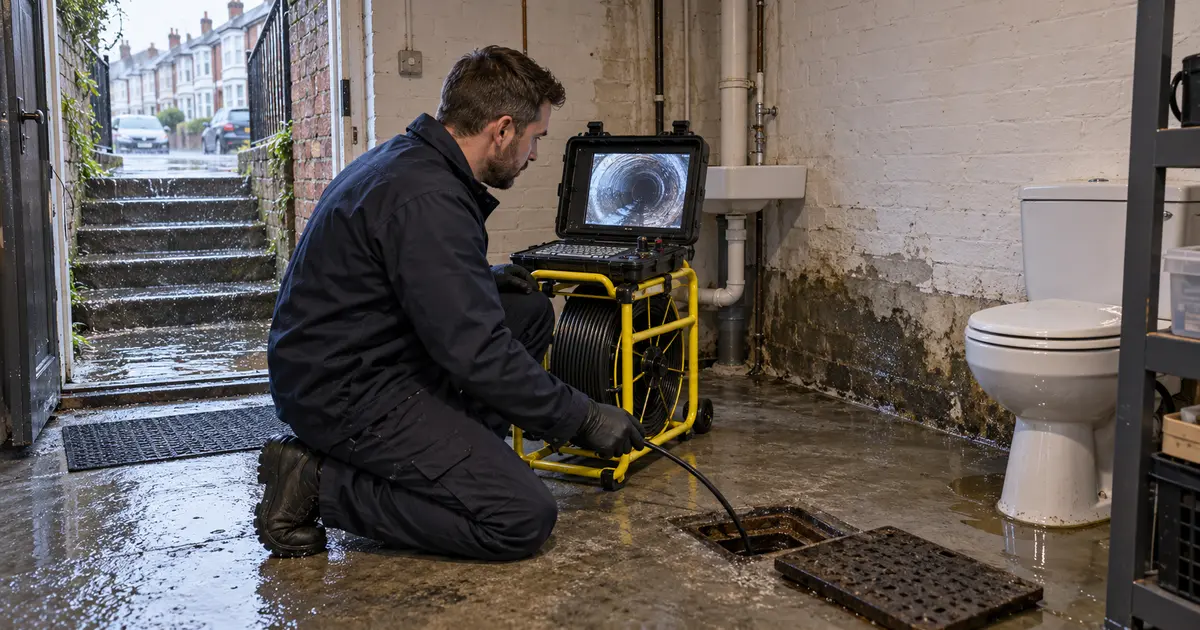
A proper check of Portsmouth basement flooding should record both what the engineer found and what the available tests could not prove.
Access chambers and flow tests
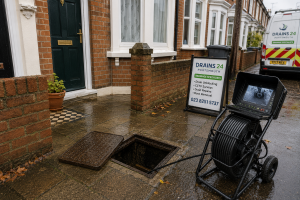
The engineer can lift covers that are safe to open and check the direction of flow. Controlled tests from individual fittings may show which pipe serves the basement. They can also reveal whether water reaches the expected chamber.
Drain clearance
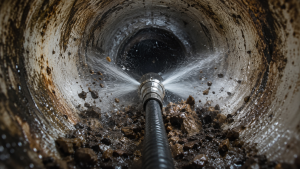
Silt, wipes, roots, grease or a lodged object can stop a survey camera. The engineer may need to clear the drain first. Once water flows, the camera has a much better chance of showing the pipe wall and joints.
CCTV drain survey
A CCTV drain survey in Portsmouth can find cracks, open joints, displaced sections, roots, scale and partial collapse. It can also show standing water inside a low or misshapen pipe.
However, CCTV has limits. The camera only shows the pipe it can enter. It may not explain water crossing the surface or seeping through a basement wall. The engineer may combine it with dye testing, drain tracing, level checks and observations during wet weather.
Drain tracing
A sonde fitted to the camera head can help trace the route from above ground. This can prove useful where old plans are missing or several flats share a drainage layout. It can also show whether the suspect pipe passes close to the wet wall.
A clear written finding
Ask for an explanation that separates confirmed faults from possible causes. Camera footage should identify the location and type of any defect. If the engineer recommends drain repairs in Portsmouth, the evidence should support the proposed method.
When does a drain need repair?
A flood does not automatically mean the pipe needs repair. If a one-off mass of wipes caused the blockage and the pipe remains sound, clearance may solve the problem.
Portsmouth owners should treat basement flooding as evidence to check, not proof of a broken drain. This approach avoids needless repair work.
Repair becomes more likely when the survey finds:
- A crack releasing water into the ground
- An open or displaced joint
- A collapsed or badly deformed section
- A low section that holds waste and blocks repeatedly
- Root entry through a structural fault
- A damaged connection serving a basement fitting
- A failed chamber or channel beside the building
The right method depends on the fault. A local patch may seal one sound section with a small defect. Lining may repair a longer suitable pipe. Excavation may provide the safest answer where the drain has collapsed, lost its fall or cannot accept a liner.
The earlier guide to Portsmouth drain repairs after repeated blockages explains those choices in more detail.
Who is responsible for the flooded drain?
Responsibility depends on the source and the pipe.
The correct contact for basement flooding in Portsmouth also depends on whether the water came from private pipework, a public sewer, the highway or the ground.
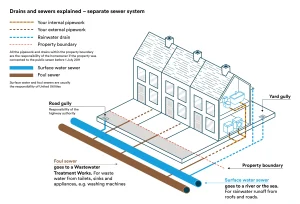
The property owner normally looks after a private drain that serves only that property within its boundary. Southern Water normally handles public sewers and public lateral drains. A shared section may fall under Southern Water even when it crosses private land.
For a block of flats, the lease and management arrangements may decide who reports and pays for work on private communal pipework. Therefore, leaseholders should tell the managing agent as soon as possible.
Use this practical starting point:
- Private drain serving one property: owner, landlord or drainage contractor
- Shared or public sewer: Southern Water
- Road gully or flooded highway: Portsmouth City Council
- Groundwater flooding: Portsmouth City Council
- Immediate danger: emergency services
If you cannot identify the source, record which properties and fittings are affected. That pattern often helps the right organisation locate the fault.
What not to do after basement flooding
Fast action helps, but the wrong action can hide evidence or make the damage worse.
Do not:
- Keep flushing toilets to see whether the water rises again
- Enter water that may reach live electrical equipment
- Remove a manhole cover during active flooding
- Assume clear water is clean
- Pump suspected sewage into the street or a rainwater drain
- Pour chemical cleaner into a backed-up system
- Fit a valve or pump without checking the full drainage layout
- Cover the affected wall or floor before finding the source
Also avoid lifting a road gully or public sewer cover. Passing traffic, pressure inside the system and displaced covers can create a serious risk.
Questions to answer before the engineer arrives
A short record can save time on site. Write down:
- When did the water first appear?
- Was rain falling at that moment?
- Did the problem follow one intense storm or several wet days?
- Where did the water enter?
- Was there a foul smell or visible waste?
- Which toilet or sink gurgled first, if any?
- Did plumbing use make the level rise?
- Were outside chambers full?
- Did neighbouring basements or drains flood?
- Has this happened before?
Photos and short videos may also show the direction of flow. Keep them for the drainage engineer, managing agent, water company and insurer.
Reducing the chance of another basement flood
The correct prevention work depends on the confirmed cause. There is no single product that protects every basement.
Preventing flooding in a Portsmouth basement therefore starts with the route of entry. The repair or protection must match that route.
Useful measures may include:
- Clearing and maintaining private channels and gullies
- Repairing cracked or displaced drains
- Correcting paving that sends water towards a basement entrance
- Moving unsuitable downpipe discharges
- Restoring safe access to inspection chambers
- Installing a designed pumped system or anti-flood valve where appropriate
- Improving flood resistance around doors and air bricks
- Using water-resistant finishes during planned refurbishment
Ask how each measure addresses the proven route. For example, a repaired foul drain will not stop groundwater moving through a wall. Equally, tanking a wall will not clear a blocked pipe that pushes sewage through a toilet.
For low-lying drainage, follow current building guidance and speak to Southern Water where sewer surcharge may affect the design. Any pump or valve must suit the fittings, flow and access available at that property.
Get help with basement flooding in Portsmouth
Basement flooding in Portsmouth needs a calm, step-by-step check. First, make the area safe. Next, note the water’s entry point and timing. Then check whether plumbing use, a full chamber, street runoff or prolonged wet weather changes the problem.
Portsmouth Drains24 can help when the evidence points towards a private drain blockage, damaged pipe or uncertain drainage route. Our engineers can clear drains they can safely reach, carry out CCTV checks, trace pipework and explain any repair findings.
For urgent private drainage help, use our 24-hour emergency drainage service in Portsmouth or call 023 8251 5737. If sewage flooding affects several properties or appears to come from a public sewer, follow Southern Water’s flooded-property guidance and contact them first.
Frequently asked questions
Can a blocked drain cause basement flooding in Portsmouth?
Yes. A blockage can hold wastewater upstream and force it through a low toilet, shower or drain connection. Stop using water and arrange a check if plumbing use makes the level rise.
How can I tell whether basement water is groundwater?
Groundwater often looks clear, enters through floors or lower walls and appears after prolonged wet weather. It may rise more slowly than surface water. However, only a proper site check can rule out a leaking drain or water pipe.
Can a CCTV survey find the cause of every basement flood?
No. CCTV can show faults inside a drain that the camera can reach, including cracks, moved joints, roots and collapse. It cannot see surface runoff or every route through the building. Engineers may also need flow tests, tracing and building checks.
Should I install a non-return valve on a basement drain?
Only after a suitable drainage assessment. A valve can protect some low-level fittings, but it stops wastewater leaving while closed. Poor design or placement may cause internal flooding elsewhere.
Who should I call if several Portsmouth properties have sewage flooding?
Contact Southern Water because the problem may involve a shared or public sewer. Tell them how many properties are affected. If only one private drain has failed within a property boundary, the owner may need a drainage contractor.
Who deals with a blocked road gully in Portsmouth?
Portsmouth City Council deals with highway gullies and flooded roads. Allow water time to fall after very heavy rain. Report the gully if it stays blocked or the water does not drain away.